| |
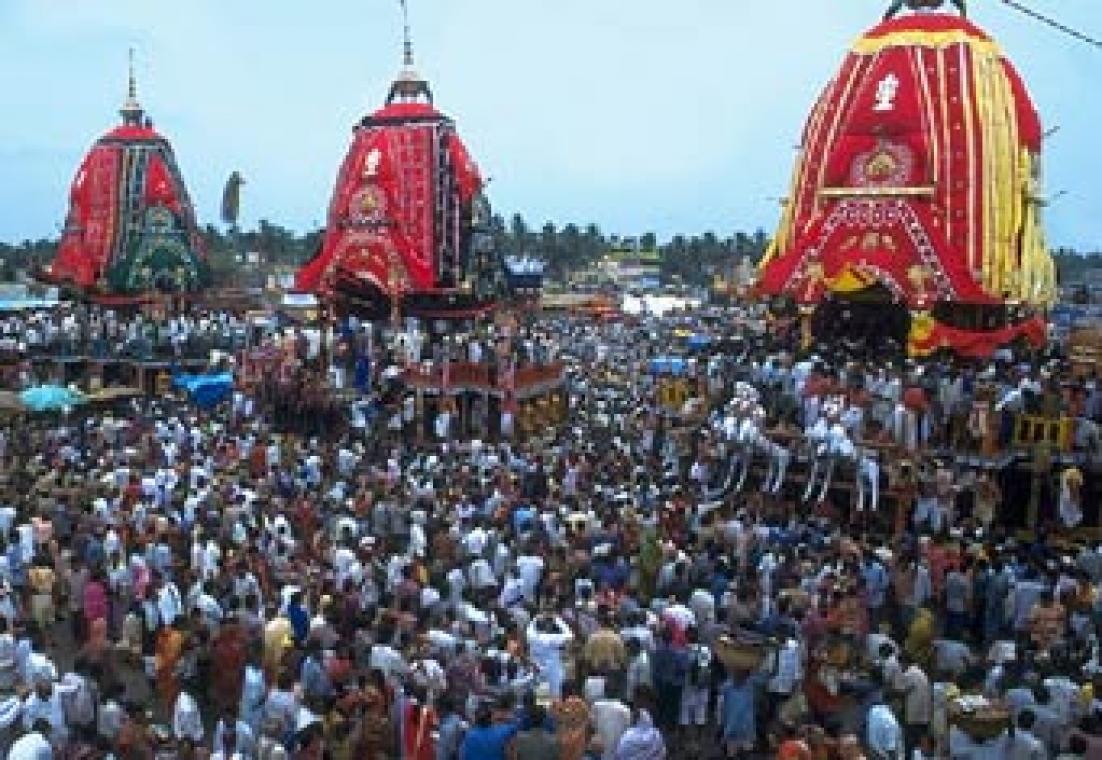
The world famous Rathayatra of Lord Jagannath is also known as Yatra and Ghosha Yatra. These Festivals are held on "ASHADHASUKLADWITIYA" ie..the second day of the bright fortnight of ashadha (June-July) every year. This Rathayatra symbolises that after a long time of the separation Lord Shri Krishna is going to Kuruksetra from Dwaraka to meet the inhabitants of Brindavan. Three different sizes of chariots are made for this Rathayatra which begins from the Lord Jagannath Temple. The Chariot of the Lord Jagannath is called NANDIGHOSH, the Chariot of Balabhadra is called TALADVAJA, the Chariot of Lady Subhadra is called PADMADHVAJA. Except the vessels of Kalasa, which are on top of the chariots, the side Deities, the Charioteers and Horses, the rest of the whole chariots are made new every year in accordance to the strict ancient specifications. Nearly around one thousands of Devotees are needed to pull these chariots with the help of four ropes which are tied to each chariot and has no steering system on it.Â
NANDIGHOSH RATH:
This Chariot is of Lord Jagannath, it is 45ft (13.71mts) high and having sixteen wheels. The fabric of the roof is in Red and Yellow colour. A wheel is placed on the top of the chariot.Â
TALADVAJA RATH:
This chariot belongs to Balabhadra. The height of this chariot is 44ft(13.2mts), and consists of fourteen wheels. The fabric colour of the roof is Red and Green. Tala fruit is placed on top of the chariot.Â
PADMADHVAJA RATH:
This is Lady Subhadra's chariot. It is 43ft (12.9mts) in height and consist of twelve wheels. The fabric of roof is in Red and Black colour.Â
There are side deities on each of the chariot as SUDARSHANA is seated by the side of Lady Subhadra in her chariot, MADANMOHANA sits in the Lord Jagannath's chariot, and small deities of Lord RAMA AND KRISHNA take their seats in the Balabhadra chariot. Thus total seven Deities are seated on the three chariots and are pulled by the Devotees by catching the ropes tied to the chariots and taken to the Gundicha Temple which is about 3km away from the main temple.Â
Before Ratha Yatra begins some Ceremonies are held in main temple. They are:-Â
(1)Â SNANAYATRA FESTIVAL:
This ceremony is held on "Jyesthapurnima", when the main deities along the Sudarsana are brought to the snanamandapa (a platform for bathing, Snana means bathing) and are bathed arount mid-day. One hundred and eight pots of water is poured on the Deities. The water is brought from a sacred well which is dear to the Goddess Sitala. After bathing the Deities are put on Elephant masks, which is called as GANESH VESHA. Then the Deities are offered BHOG (Cooked Food) and ARATHI. The Deities are then taken back to the temple in a procession and stay in retirement for fifteen days. The deities are placed in the Hallway between the inner and outer shrine in a semi-horizontal position. Here in this ceremony the general public can see the food Offerings to the Deities, which is not possible any time in the year.Â
(2)Â ANAVASARA FESTIVAL:
During these  Festivals after Snana Yatra Lord Jagannath become sick and suffers from fever. He is therefore moved to his private stay, there He is offered drugs which are prepared by the fruit juice. The Dayita (servants of Lord Jagannath) take care of Lord Jagannath. They sleep and stay there with the Deity. The word ANAVASARA is used when Lord Jagannath is not seen in the temple.Â
(3)Â NIBHRITA FESTIVAL:
The fifteen days period of Resting and Renovation is called NIBRITHA. Honouring the isolation of his wife Goddess Laxmi, Lord Jagannath lives there in privacy enjoying SVAKIYA RASA. Then by taking her (Goddess Laxmi) permission Lord Jagannath come out for His Rathayatra.Â
(4)Â ANGA-RAGA OR NAVA YAVANA FESTIVAL:
These Festivals are held for the purpose of renovation of the Lord Jagannath body. After being washed the body of Lord Jagannath needs repainting, This work is done by the DAITYAS, which takes two weeks to complete. Then the Lord Jagannath Deities is fully restored to youth (NAVA YAVANA).Â
(5)Â NETROTSAVA:
This ceremony is performed in the inner shrine where the Deities are placed in semi-horizontal position. They have been fully painted, except their eyes. In this ceremony the eyes of the Deities are painted by their respected Pujaries and the Puja (worship) is started in the temple. The Deities are still in the same position.Â
After completing the above said ceremonies the Deities are taken out from the temple and placed in their respective chariots on the Rathayatra day.Â
The procession of the Deities from the temple to the chariot is the most colorful aspect of the Rathayatra. The Chariots are brought and kept at front of the Simha Dwara, facing north side before Rathayatra begins. In a traditional ceremonial manner first Sudarshana is brought from the temple and put on to the Chariot of Lady Subhadra, followed by Balabhadra first as is elder in the family placed in his chariot, then followed Lady Subhadra and Lord Jagannath are placed in their respective chariots.Â
While bringing the Deities of Balabhadra and Lord Jagannath out of the temple they are made to swing forward and backward in a manner called "PAHANDI". As the Deities are extremely heavy they need many strong men to move them. Each Deity is provided with thick soften ropes around their body. By taking assistance from the Pujaries who holds the ropes, the Dayitas(Lord Jagannath servants) move the Deities. As the main Deities arrive on their respective chariots ,the small Deities of Lord Rama and Krishna are placed on the Balabhadra chariot and Madanmohan Deity is placed on Lord Jagannath chariot. All Deities are then refreshed and offered fresh garlands. At this time in a Palanquin the king of Jagannath Puri arrives and sweeps the street in front of the chariots with a golden handled Whisk broom-stick and sprinkles the ground with fragrant waters.Â
After all this Rituals completed the Rathayatra begins with the Balabhadra chariot going first as he is elder. Then follows chariot of Subhadra and then follows chariot of Lord Jagannath. The chariots of Lady Subhadra and Balabhadra reach directly the Gundicha temple, where as the chariot of Lord Jagannath stops at his Mausima (Aunt's) Goddess Ardhamsini temple. Here the Lord is offered with Poda Pitha(fried cheese cake). Again the chariot of Lord Jagannath proceeds towards the Gundicha Temple. However the Rath (chariot) of the Lord Jagannath usually reaches the Gundicha Temple next day. After reaching the Gundicha Temple the Deities take rest on their chariots for another day ,then they are taken into the sanctum of the Gundicha Temple. while staying in the Gundicha temple for seven days the Deities receive all the routine Rituals same as they used to receive in the main temple.Â
On the 10th day, fortnight of Ashada the Deities are brought back on to their respective Chariots and the Rath is pulled back to the main temple, this is known as BAHUDA YATRA. While returning to the main temple Lord Jagannath stops again at His "Mausima" Goddess Ardhamsini temple and receives BOGH(Poda Pitha). He then proceeds towards the King's palace where he has a meeting with Goddess Laxmi and continues his Yatra and the Rathayatra reaches to an end i.e.. to the Lord Jagannath Temple at night and spend their night in the Rath till Morning.Â
Next day in the morning on BADA EKADASI the Deities are Dressed in the SUNA VESHA(THE GOLDEN-DRESS), Arms and Feet which are made of pure gold are attached to the Deities, and are decorated by putting on them the Golden Ornaments and Golden Crowns. This day is considered to be the most auspicious day of the festival. The devotees makes Pradhakshina of the rath(chariot) by moving around the chariots. After a few hours the golden ornaments are removed from the Deities and brought back to the temple, As usual first comes Balabhadra then Subhadra and then Lord Jagannath in a traditional procession among huge assembly of thousands of devotes.Â
Lord Jagannath faces a tough time when he tries to enter into the temple, as Goddess Laxmi is angry with Lord Jagannath because he went to Rathayatra along with his Brother and Sister She also expresses her anger by going to the Gundicha Temple on 5th day of the festival. The DEVIDASIS (servants of Godess Laxmi) close the Simha Dwara and ultimately opens it again but closes the Jaya Vijaya Dwara, Hear songs comprising of dialogues exchanged between DEVIDASI and DAYITAS. Then Lord Jagannath tells to Goddess Laxmi if he is allowed to enter into the temple He will present her so many gifts, listening to this Goddess Laxmi allows Lord Jagannath to enter into the Temple. Thus Rathayatra is completed. |